How to Thread a Sewing Machine and Wind a Bobbin
Wind the bobbin, follow the upper thread path from spool to needle, and bring up the bobbin thread. A step-by-step guide to threading a sewing machine for the first time.

Learning how to thread a sewing machine is the first real hurdle with a new machine, and it is far less mysterious than it looks. The upper thread follows one fixed route from the spool to the needle, a second thread comes up from a small bobbin underneath, and the two lock together inside the fabric to form each stitch.
Machines differ in the details, so keep your manual open beside you. Many machines also have small numbers or arrows printed on the body that mark the route. The steps below describe the layout most home machines share. If a part name is unfamiliar, the guide to the parts of a sewing machine shows where each one sits.
Before You Start
Three small habits prevent most threading problems:
- Raise the presser foot. Lifting the foot opens the tension discs, the pair of plates that grip the upper thread. If the foot is down while you thread, the thread rides on top of the discs instead of between them, and the machine sews loose, loopy stitches.
- Raise the needle. Turn the handwheel toward you until the needle is at its highest point. The take-up lever, the metal arm that moves up and down at the front of the machine, will then be visible and easy to reach.
- Cut the thread end cleanly. A fresh cut made at an angle with sharp scissors passes through guides and the needle eye much more easily than a fuzzy end.
Keep your foot away from the pedal while your fingers are near the needle. If your machine has a power switch, turn it off for the needle-threading step.
Wind the Bobbin First
The bobbin is the small spool that holds the lower thread. Wind it before threading the top, because winding uses the same spool of thread.
- Place the spool on the spool pin. Add the spool cap if your machine has a horizontal pin.
- Lead the thread around the bobbin-winding guide, usually a small round button on top of the machine. Snap it firmly into place so the thread winds under light tension.
- Pass the thread end through the small hole in the bobbin from the inside to the outside.
- Push the bobbin onto the winder spindle and slide the spindle sideways until it clicks into the winding position.
- Hold the thread tail straight up, press the pedal for a few turns, then stop and trim the tail close to the bobbin.
- Wind until full. Most machines stop or slow down on their own. Cut the thread, slide the spindle back and lift the bobbin off.
Watch out
Use only the bobbin type listed in your machine’s manual. Bobbins that look almost identical can differ slightly in height or shape, and the wrong one can cause skipped stitches, jams and noisy sewing.
Thread the Upper Thread
With the presser foot up and the needle at its highest point, follow the route from spool to needle.
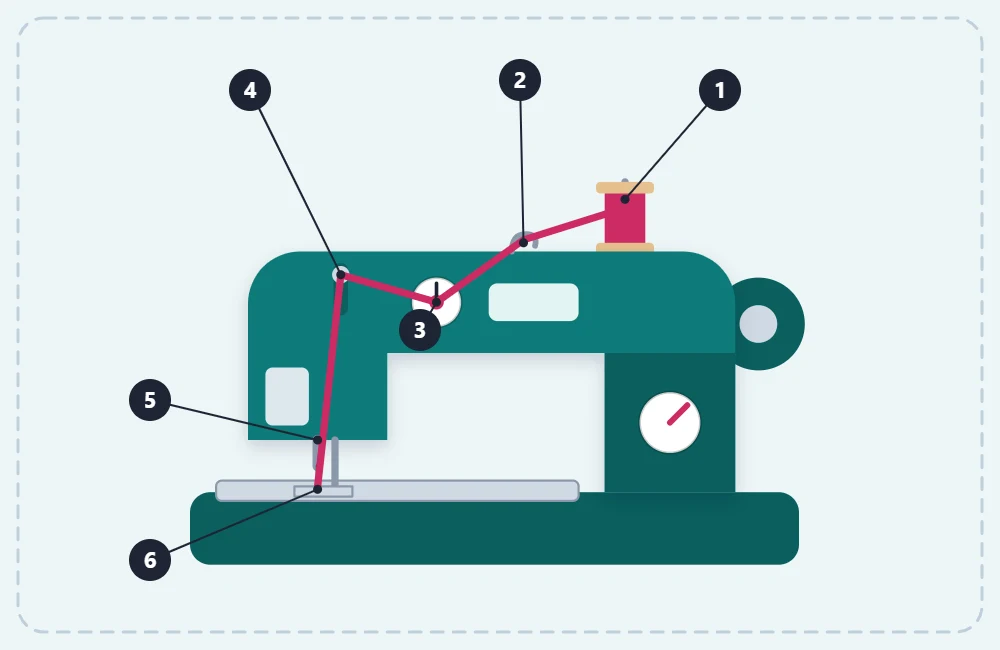
- Start at the spool pin. The thread should pull off the spool smoothly without catching on the spool’s edge.
- Hook the first thread guide. This is the small metal or plastic guide at the top of the machine.
- Go down the tension channel. Bring the thread down the right-hand slot on the front of the machine. The tension discs are hidden inside this channel.
- Come up to the take-up lever. Make a U-turn at the bottom of the channel, travel up the left-hand slot and pass the thread through the eye or slot of the take-up lever from right to left.
- Go down to the needle guide. Bring the thread straight down and slip it behind the small guide just above the needle.
- Thread the needle. On most home machines the thread goes through the eye from front to back. Pull about 4 inches (10 cm) of thread through and lay it toward the back.
If the thread refuses to enter the eye, trim it again. A built-in needle threader, if your machine has one, works differently from model to model, so check your machine’s manual for that step.
Insert the Bobbin
Home machines use one of two bobbin systems. Look under the needle plate: a clear cover on top means a drop-in bobbin, and a small door on the front of the machine means a removable bobbin case.

Drop-In Bobbin
Slide off the cover and drop the bobbin in so the thread unwinds counterclockwise; seen from above, the tail hangs off the left side like the letter P. Pull the thread into the notch and along the curved slot until it seats, then replace the cover.
Front-Loading Bobbin Case
Remove the metal case, place the bobbin inside and draw the thread through the slit and under the flat spring until it comes out at the opening. The direction of the thread matters here too and varies by machine, so follow the diagram in your manual. Push the case back in until it clicks.
Bring Up the Bobbin Thread
Hold the upper thread tail lightly with your left hand. Turn the handwheel toward you one full turn so the needle goes down and comes back up. The upper thread catches the bobbin thread and pulls up a small loop. Tug the loop until the bobbin tail appears, then slide both tails under the presser foot and toward the back.
Test Your Threading
Fold a scrap of woven cotton in half, lower the presser foot and sew a line about 4 inches (10 cm) long. Look at both sides. Even stitches on top and underneath mean the machine is threaded correctly, and you are ready to practice sewing a straight seam.
A tangle of loops under the fabric almost always points to the upper thread, not the bobbin. Raise the presser foot, pull the thread out completely and thread again from the spool. If the stitches still look uneven, the next things to check are the needle and thread, covered in the guide to machine needles and thread, and then the settings described in sewing machine tension explained.
Tip
Unthread and rethread the machine five times in a row on your first day. The repetition makes the route automatic, and rethreading is the first fix for most stitch problems.
Frequently asked questions
Why does the thread keep coming out of the needle at the start of a seam?
The thread tail is too short or the take-up lever was not at its highest point when you started. Pull about 4 inches (10 cm) of thread through the needle and raise the needle fully with the handwheel before each seam.
Can a bobbin from another sewing machine be used?
Only if it is the exact type your manual specifies. Bobbins come in several sizes and shapes that look alike, and a near match can cause jams and poor stitches.
Does the machine have to be unthreaded to wind a new bobbin?
On most machines, yes, because winding uses the same spool pin. Some machines have a second spool pin for winding, so check your machine's manual.
How full should a bobbin be wound?
Wind it evenly until the machine's bobbin winder stops or the thread sits just below the rim. An overfilled bobbin may not turn freely in its case.